










12th February 2026 · Metronome
Metronome: The French Connection

Metronome are probably best described as a high-end boutique French brand, located in a small town near Toulouse in the south of France. They are an unassuming company in many ways, and they never jump up and down about their products, preferring instead to let the music do the talking.
Founded in 1987, their first product was a loudspeaker called the MT-1. Shaped like a Metronome, it provided inspiration for the name of the company. Over the following years, they switched to designing CD players, developed in conjunction with another high-end French brand, Jadis.
Metronome’s current owner, Jean Marie Clauzel, purchased the company in 2013 when the original owner retired. Over subsequent years, a comprehensive selection of new products were developed, all designed and handcrafted in-house, allowing them to make the transition to a company who specialise in every aspect of digital audio as opposed to just CD-based products.
Fast forward to today, and you will find Metronome designing and manufacturing CD players, CD transports, DACs, Network Streamers and Network Servers.
There is no doubt that over the past few years, the musical landscape has dramatically changed; network-based music with Qobuz/Tidal subscriptions has undoubtedly become the most popular playback method, and it’s not hard to see why: it’s convenient, easy to use, and sounds great. However, some effort is required to optimise the network in a streaming system in order for it to gain parity with CD performance. The home network is a hotbed of noise, and once this is correctly dealt with, streaming can become an incredibly compelling and elegant solution.
CD has remained strong as a format. I have clients discovering (and some re-discovering) just how good CD can be, and Metronome has played a pivotal role in this for quite a few customers. Many have become almost complacent with CD as a format, with collections being boxed up and put in the bottom of a wardrobe, the loft, or even donated to a charity shop. Those 12cm silver discs are incredibly capable when spinning in a high-end CD player or transport, more so than many people realise or remember.
As well as CD and streaming, we also have ‘file-based playback’. This has been a very popular option and has been championed by myself over the past few years with brands such as Melco (who are now called DELA). File-based playback is essentially music stored locally on a network device, which is served to a DAC. This is arguably less convenient than a streaming solution, as you need to have the physical library to begin with, but it is an incredibly viable option for many and offers tremendous performance.

Metronome’s comprehensive product range has extensively covered all of these bases. This diversity has put Metronome in an incredibly strong and enviable position within the marketplace, and over time, they have developed three distinct groups of products, each at different levels in terms of performance.
The Digital Sharing range is Metronome’s entry-level group of products, and it consists of a DAC, Network Streamer and CD Transport, each priced at £4800. There is also a dedicated Network Server for file playback, the DSAS, which is £6200. I’ve not received my demonstration DSAS at the time of writing, so other than a brief overview, I’ll not be discussing this model in depth in this blog post, but it is definitely one for the future.
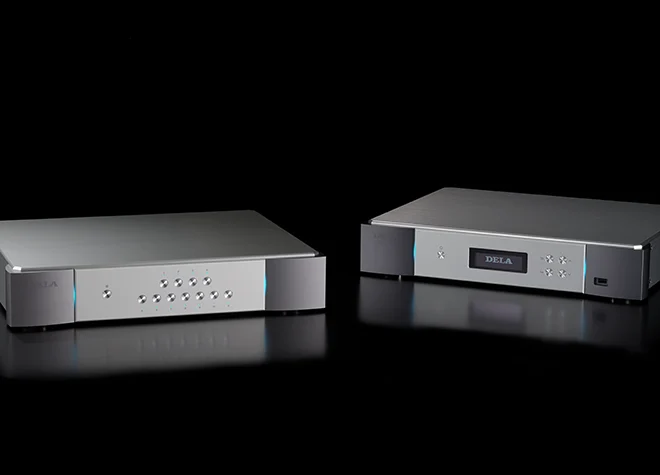
Each Digital Sharing model measures just 25cm square and stands at only 7cm tall. Build quality is excellent. With each model weighing in at just under 5kg, they feel reassuringly heavy and solid. With a thick stainless steel chassis and a brushed aluminium front panel, the small sections on the front panel are designed to mimic the keys of a piano.
If you look under the hood, you will find they are incredibly substantial with meticulous attention to detail. With each model, every square centimetre of available space is fully utilised with proper toroidal power supplies.
The DS range of products offers something for everyone, whether building a complete digital front end with CD, streaming and a DAC, or growing into the eco-system piece by piece as budget permits. Customer requirements obviously differ; some will only want to add a single unit, whereas others will want to add each model to their system.
A great example of the single box solution is the DST CD transport connected to a digital input on the Vitus RI-101 mk2 DAC board. It has been a particularly elegant and popular solution over the past few months, instantly giving customers a simple entry back into enjoying CDs again.
Each model in the range possesses a level of performance which belies both the size and the simplistic nature of each product – elegance, refinement and realism are all key standout sonic features.

DSc Mini DAC
The DSc Mini is the Digital Sharing DAC and is loosely based on the popular Le DAC 2 from the Classica range. It uses the well-regarded ES9026PRO DAC chip, which is also used in Le DAC 2. Metronome don’t divulge a lot of information about how they use this chipset and how they get the best out of it at the price point, but listening should tell you everything you need to know.
There are five digital inputs (USB B, Optical, SPDIF, AES-EBU and I2S), plus RCA and XLR analogue outputs. If used with other Metronome products (like the DST or DSS 2), the I2S interface is the recommended method of connection for obtaining maximum performance. It’s important to note that a few brands use I2S as a connection, but the pin configuration isn’t standardised. Different combinations are not guaranteed to work, but there is no issue using I2S in an all-Metronome ecosystem.
The DSc Mini has a large screen, which is really refreshing and easy to read from the other side of the room. The screen shows you the selected input and the current sample rate. It is very much a no-frills DAC, digital in and analogue out. It offers no volume control and no remote, with input switching done via the front panel. Metronome has put the budget into performance, not an endless list of features most people don’t need or won’t use.

DSS 2 Network Streamer
DSS stands for Digital Sharing Streamer, and this model is the replacement for the original DSS, which was Metronome’s original network player/streamer. This new model is visually identical to the outgoing model, but internally it has been redesigned from the ground up – nothing has been carried over from the original model, other than the casework. The front panel is incredibly elegant and simple, adorned with just a single LED. There is no screen to display what is being played; that is handled by whatever control point you choose to use.
The DSS 2 is an incredibly well-specified product and offers a plethora of options for both streaming and, critically, how you control it. Metronome don’t have their own app, but the DSS 2 is J-Play certified. Streaming Tidal/Qobuz using J-Play is incredibly intuitive; it’s a superb app and fast becoming the go-to control point for many. It works well with Mconnect, plus it is a Roon Ready Endpoint, and is also compatible with Plays with Audirvana.
In addition to the above, you also have the options to control the DSS 2 via Qobuz Connect, Tidal Connect and Spotify Connect, each of which works flawlessly. It also fully supports UPnP/DLNA and vTuner via Mconnect.
You can connect the DSS 2 to your network via Ethernet or Wi-Fi. There are three different digital outputs: SPDIF, AES EBU, and I2S to connect to your DAC.

DST – CD Transport
As touched upon above, there is no question that CD playback has been having somewhat of a resurgence over the past 12 months or so, although many customers will argue that it never actually went away in the first place. It’s telling that since its launch, the DST has been the most popular product from this range.
The DST shares the same digital outputs as the DSS 2, with SPDIF, AES-EBU, and I2S available, so plenty of flexibility to connect to the DAC.
The DST is a standard red-book CD transport, but you do have the option to upsample that 16/44.1 signal if you wish. The SPDIF and AES-EBU outputs handle PCM up to 32-bit/384kHz and DSD up to DSD128. The I²S output supports PCM up to 32-bit/384kHz and DSD up to DSD256.
The slot-loading mechanism chosen by Metronome for the DST was specifically designed to handle Red Book CDs, and is not an off-the-shelf, IT-style drive repurposed for CD playback.

DSAS Audio Server
The newest addition to the Digital Sharing range, the DSAS, stands for Digital Sharing Audio Server. This is the first server that Metronome have produced, and it has been designed in conjunction with Audirvana, another French company. Essentially, Metronome designed the hardware, and Audirvana provided the software.
It comes supplied with 2TB of NVMe SSD storage, and you can add an additional 2TB drive if you require more storage. On the rear, there is a network connection and a USB output to connect to a DAC. There are also USB-A and USB-C sockets on the rear for connecting external storage.
Provided with each DSAS is a three-year subscription to Audirvana Studio, which is the app/software needed to control the DSAS. As well as playing stored files, it will also allow streaming from Qobuz, Tidal, Hi-Res Audio, and Internet Radio.
We’ll be covering this in greater depth in the near future – it certainly looks like it will have relevance for plenty of customers.

Exquisite performance
I’ve spent considerable time with the DSC Mini, DSS 2 and the DST over the past few weeks, and they combine effortlessly to form a brilliant digital solution.
I used a Vitus RI-101 mk2 integrated amplifier with a pair of OePhi Transcendence 2.5 speakers to complete the system. This pairing has proven itself time and time again since we added OePhi to our portfolio last year. It is a superb combination and is incredibly musical, transparent and ever so rewarding.

These three compact units look fantastic when they are stacked together. High-performing systems that don’t take up excessive real estate are an important consideration for many, and it is an area we enjoy specialising in. Of course, not everyone will require all three models for their system; there are plenty of customers who will simply require a single unit, such as an upgraded DAC or adding CD playback or streaming to their existing DAC.
When fed with a CD or a high-quality Qobuz stream, the DSC DAC is a remarkably capable little unit. As mentioned above, it’s a no-frills DAC, and it sounds all the better for it. The music is bold and confident with a presentation that is incredibly rich and colourful. It possesses superb levels of detail, transparency and openness, but it never pushes the music into being analytical or etched. Many digital devices seem to place incredible emphasis on detail retrieval, but they lack that sense of richness and colour, which is what makes the music so engaging in the first place.

Leading edges are natural and never make you feel like you are being pinned to your chair. There is a wonderful sense of realism, and the DSc Mini is superb at unlocking subtle nuances and textures in the music, creating a real sense of space and atmosphere. One of my go-to albums whenever I’m evaluating new components is ‘Diamond Mine’ by Jon Hopkins & King Creosote, and it certainly doesn’t disappoint.
Musical completeness and cohesiveness are more important to Metronome than squeezing out every last drop of resolution, and it’s something which dovetails perfectly with my way of thinking and system building. Once furnished with low noise cables and ancillaries, this is a product range which really can push the performance way past what the price point might suggest. You could easily spend more money on a DAC but end up with an analytical, cold, uninviting presentation.
CD or streaming?
I’ve supplied several DST CD transports over the past few months, all being used with a variety of different DACs. In each case, a demonstration has resulted in customers being very taken aback by what they heard, exceeding initial expectations every time. I have had plenty of customers who own large CD collections, and upgrading from a basic transport or older CD player to the DST resulted in CD taking a step back into the limelight for many.
For those who put more focus into streaming, or for those who have sold or disposed of their CD collection, the DSS 2 is an attractive proposition, as a couple of initial demonstrations have proven. As mentioned above, it covers all streaming bases and performs to an incredibly high standard. To get the best from streaming does require a little effort, as the home network is a noisy environment, and there are a few elements to consider here.
A customer who was in the demonstration room last week asked me which was the better-sounding unit, the DST or the DSS2. There isn’t a clear winner in reality. If you compare a CD vs a stream of the same music, on some albums the CD will win out, whereas with other albums the stream sounds better, and there are many cases where there is very little in it.
The DSc Mini DAC is incredibly capable, and it will happily sit at the centre of a great system. As is always the case, the performance is dictated to some degree by what you feed into the DAC to begin with, and this is something that many people underestimate. The DST and DSS 2 are perfect partners for the DSc Mini by design.
Cabling, optimisation & final thoughts
Each piece within the Digital Sharing range has been finely tuned by Metronome to really allow the music to shine through. As ever, to get the finest possible performance from a component, the right combination of low noise cabling pays dividends to ensure you are getting the best from these products and your system as a whole.
The Vitus RI is an enormously powerful amplifier with huge grip, and it has a wonderfully transparent top end, but one which is flavoured with a touch of sweetness. Combined with the Metronome components and the OePhi speakers, a full OePhi cable loom really complemented it beautifully. Just like their speakers, OePhi cables place huge emphasis on maximum bandwidth, timing and neutrality. We used their Transcendence cables to match the speakers, and when combined together, the end results are incredibly strong. Lowering noise levels and opening the system up gives you a real insight into the music that is playing.


Shunyata Research offers an incredibly strong alternative. Another brand which excels at lowering noise levels, in this system, the Shunyata Theta is a touch more demure, relaxed and smooth-sounding than the OePhi, but an equally viable choice. I suspect just as many customers would favour this option as the OePhi, it all hinges on the preferred presentation. Ultimately, neither will disappoint. The product slider below shows the various OePhi and Shunyata cables which were used in this system.
To finish off, it’s fair to say that Metronome have really done something special with the Digital Sharing range. The DST, DSS 2 and DSC Mini are incredibly strong products, and whilst £4800 for each model isn’t exactly ‘entry level’ in the strictest sense, they offer sensational value for money. When correctly optimised in a system, they elevate themselves to a whole new level as well. They are truly rewarding products and ones which simply make you want to keep listening to music, which for me is the whole point of this wonderful hobby.
We keep the DST, DSS 2 and DSC Mini all on permanent demonstration. Please get in touch if you would like to arrange a listen, as ever, part exchange is welcome.
Another Metronome blog will be appearing soon, so please keep a lookout.