










Lowering the Noise Floor
Our guide to optimising your system - Acoustically, Electrically & Mechanically

If you have a hi-fi system which is skipping a beat, sounds aggressive and fatiguing or simply isn’t as musically engaging or rewarding as you’d like it could be that you require some ‘Audio Therapy’ to ensure that it is performing to the best of its ability.
The fact is the vast majority of people will have never heard their system sound anywhere close to its full potential.
Many hi-fi enthusiasts are continuously on the upgrade path, ever seeking “audio nirvana”. This can be a very expensive and never ending journey for many but there is another way to get far greater performance and satisfaction from your system and the changes can be rather dramatic.
I’ve written quite extensively over the past few years about lowering the noise floor and how much of a benefit it can bring to a systems performance when you do it correctly. All systems are different and everyone has different tastes so the angle of attack to some degree will vary from one system to another but the fundamental goal always remains the same – removing noise, distortion and interference from the system. We can drop the noise floor in just one component or across the whole system and we can do it regardless of whether we’re dealing with a signal in the digital or analogue domain.
By lowering the noise floor we are essentially making a system more natural and accurate whilst retaining the drive and flow and most importantly the message of the music. It’s not all about extracting every last drop of detail or transparency, but more do with making your system engaging and rewarding. I speak to lots of people who have systems which they enjoy but over extended listening sessions they can become fatigued with the performance from the system and they frequently need to take a break!
An Audio Therapy system will be focussed on lowering noise from inception and as a result the performance will be endlessly detailed, but also retain that wonderful trait of being completely natural and fatigue free – just more one track turns into another couple of albums and a late night quite frequently!
To quote Miles Davis:
‘it’s not the notes you play, it’s the notes you don’t play’
…that that analogy can be used here, that silence between the notes, or that pause before a vocal starts…..with a dramatically lowered noise floor you uncover so much more of the music, subtle detail and nuance – so much of the magic in the music we love is buried away and many never get to truly exxperience it.
Many of my customers have had good systems for many years, but I have taken many of them further than they thought was possible in a relatively short space of time with some careful additions. Depending on the system and the customers preferences the products used can vary from one system to another, there isn’t a magic recipe card or a one-size fits all solution, it’s one of the reasons there are so many options to explore.
There are 3 key areas which we always focus on to lower the noise floor, acoustically, electrically and mechanically
Acoustically

Room Acoustics is without doubt the most overlooked aspect of the home audio system. The room itself is frequently the weakest link in a system and to some degree all rooms will introduce distortion, smearing and the ‘muddying’ of the sonic presentation and is guilty of holding back the musical message a system is trying to communicate.
In a typical average sized room only around 20% of what you hear comes directly from the speaker, the other 80% comes from the room, in the form of reflections, rebounding many times around around the room, the percentages will vary depending on room size. Treating your room essentially involves moving this unfavourable ratio so you increase what you hear directly from the speakers and reduce what you hear as reflections and resonances.
With the use of Acustica Applicata Room Treatment we have at our disposal one of the most powerful acoustical solutions available today, we can map and measure your room, work out accurately what the issues are and propose solutions that will drastically improve your system and often by a far greater margin than any component upgrade could ever provide.
To find out more on Room Acoustics, Room Treatment, Acustica Applicata (and the brilliant Stillpoints Aperture II Wall Panels) please take a read of the blog post below

Electrically

Most audio systems will be made up of multiple components and to varying degrees these products will create noise and also pick up noise, both from the mains and from other connected components.
The musical signal is incredibly delicate and to maximise any systems performance we have to carefully look after that signal as it passes through the components in the system, protecting it from noise and pollution along the way.
You obviously can’t hear this noise when you listen to your system, but if you can effectively deal with and remove it from the signal path you can make a profound improvement to the performance and this is where Entreq can step in.
Entreq – Energy Transforming Equipment
Entreq are a Swedish company, founded in 2007, their name is an abbreviation of the term “ENergy TRansforming EQuipment’
Entreq produce an extensive range of products, cables and accessories, but they are probably most well known for their range of ground boxes, which are designed to remove high frequency noise from whatever component you connect them to.
They have been a pivotal brand for me over the past 9 years and they’ve become an essential tool to improving system performance.
As touched on above, every electronic device generates noise, both unwanted radio-frequency (RF) and electromagnetic interference (EMI). Much of this noise accumulates in the signal-ground reference (the point against which all audio voltages are measured). When this reference carries high-frequency contamination, it introduces instability and masks fine detail, reducing an audio system’s ability to resolve low-level information.
It’s important to highlight the purpose of an Entreq Ground Box, what they do and critically what they don’t do.
Entreq ground boxes do not replace or replicate the safety ground, nor do they attempt to improve mains power quality directly.
Their purpose is different: they are designed to provide an alternative, lower-impedance pathway for high-frequency noise that would otherwise remain within the signal circuitry of your equipment.
Connecting an Entreq Ground Box to your System
Connecting a ground box to your system couldn’t be simpler. Take a ground box, like an Olympus Ten T for example and an Apollo Ground Cable, connect the hook end of the ground cable to the post on the back on the ground box and connect the other end of the ground cable to the desired component.
A spare RCA connection on an amplifier, DAC or CD player, a spare RJ45 connection on a router or network switch. Entreq make a wide variety of termination options, there is RCA, XLR, USB, RJ45 and BNC options available for example.
This connection creates a drain which removes the pollutants present in the signal circuitry dumping them into the ground box.
The sonic improvements this brings is quite often something you will hear instantly, but in many cases it takes a couple of tracks being played before you hear that something is changing, it’s important to stress it is not like a flicking a switch.
One of the first things people notice is an overriding sense of calmness to the music. Things don’t slow down and they don’t roll the detail off, but you get a reduction in coarseness and grain. The dynamics and detail improves and you get better timing, focus and stability as result.
It can deliver a powerful message and most people are surprised when they experience it for the first time.
Whether you connect just a single component to a small ground box like a Macro Kit or multiple components to several boxes depends on your system and budget. There is no right or wrong path to take and it one of the reasons why there is such a comprehensive selection of Ground Boxes Kits and Cables
I have a lot of experience with Entreq and can take any system further with the right combination of items.
Learn more about the range of Entreq Ground Boxes
Shunyata Research also make a range of grounding products, based around their grounding hub, the Altaira and Altaira X. We keep these on demonstration as well and they are another superb solution. These will be covered separately below with the other Shunyata products.
Power to the System

Mains power is noisy, and that noise gets in the way of the music before it’s even reached your system.
This is something that many don’t even consider, but it is almost always the starting point when I’m building a system.
Everything in your that uses mains powers creates noise – your fridge-freezer, washing machine, tumble dryer, computer, router, chargers, smart lights, the list goes on. Included within this long list is the audio system, it is guilty of creating its own noise and feeding it right back into the system.
Without addressing this at the source, everything you are trying to achieve with your system is built on a compromised foundation.
This is one of the reason why Shunyata Research have become such an important cornerstone when creating a system here at Audio Therapy. Shunyata’s founder and owner, Caelin Gabriel background was in designing ultra-sensitive data acquisition systems for the US military, detecting signals otherwise buried in random noise, and that expertise in understanding noise at a fundamental level has made a transformative impact upon audio systems at all levels.
Shunyata have numerous products that are used in recording studios, mastering suites and even a dedicated range for surgical equipment, environments where signal integrity simply cannot be compromised.
The NR power cables are designed improve literally flatten a soundstage. They give you a quieter background with improved separation notes and more quietness between the notes. Once this noise is removed the impact it delivers can be profound.
They also have a range of power cables, called XC, these cables eschew the noise reduction is favour of optimised current delivery and they are specifically designed to use on Shunyata’s range of power conditioners.
I keep every Shunyata power cable and power conditioner on permanent demonstration and it’s unusual for a customer that isn’t taken aback by the impact they can make on system performance. The improvements they make are not subtle, they are quite the opposite.
This is why I always encourage customer to think about power early in the process of building a system, not as an afterthought once the electronics and speakers are chosen.
A system built on noisy mains will always be working against itself to some degree, no matter how good the actual components are.
Shunyata isn’t a luxury add-on at the end of a system, it’s foundational and over the past few years have become one of the most important brands that we offer.
Mechanically
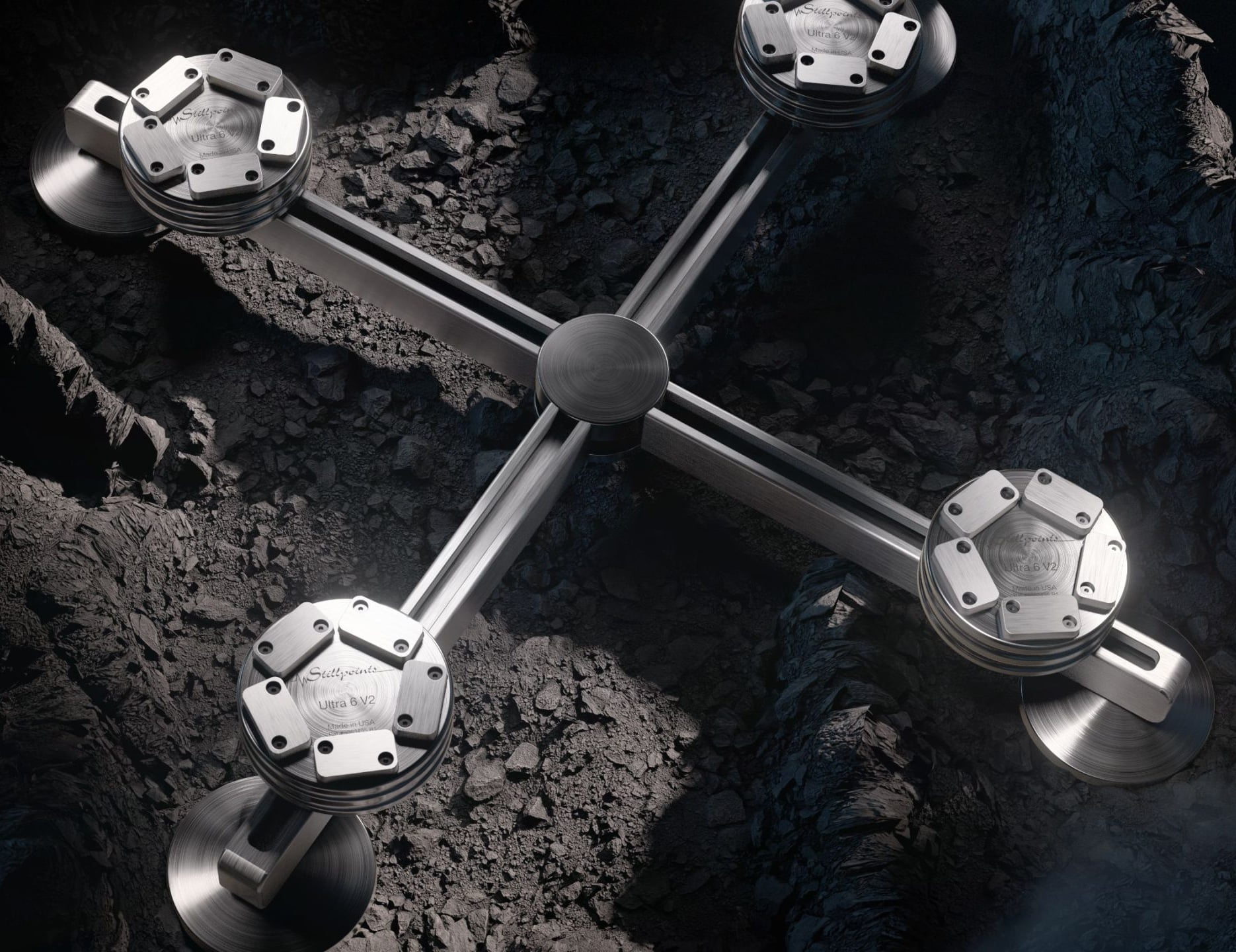
Here we are dealing with a few different elements – but essentially all related to the energy created by the products themselves and how that energy is dealt with, as well as looking at what your system is actually standing on. This primarily relates to Stillpoints, how we use them and most importantly when we introduce them into a system.
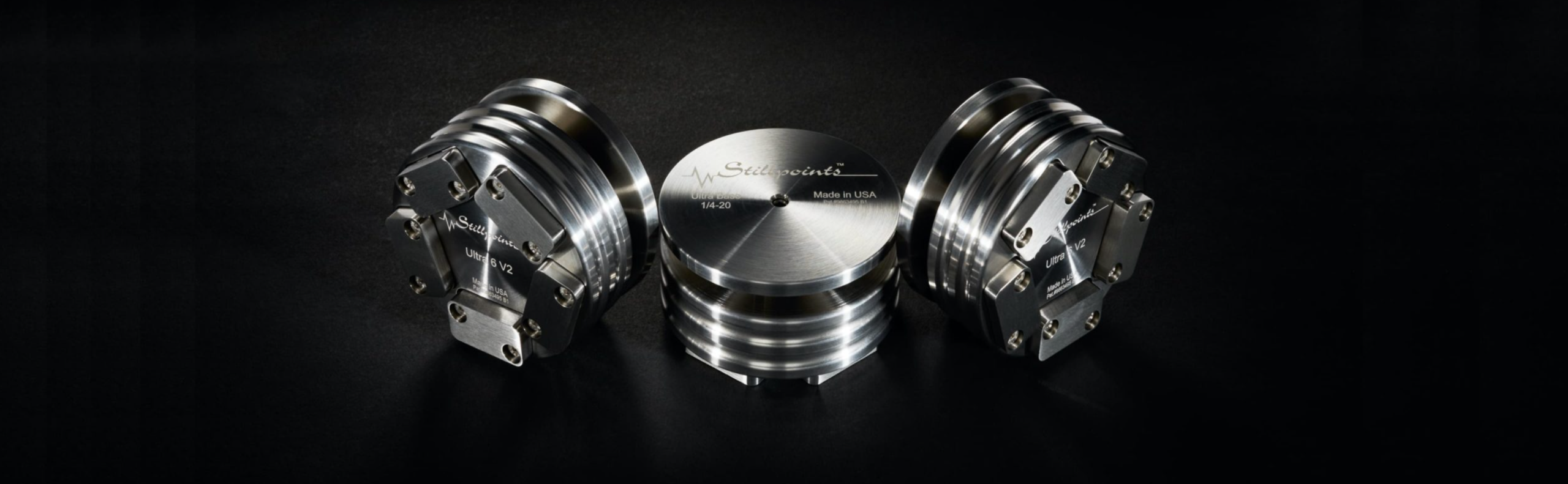
Stillpoints are isolation devices that in simple terms make your electronics and loudspeakers float. They absorb the unwanted mechanical energy that is created by your system, and they also ensure that the glass shelves and metal rack your system sits upon has no influence on the presentation of your system (because it does). Exactly the same applies for your loudspeakers sitting on the floor or on stands.
Stillpoints are incredibly effective and powerful devices, but in terms of lowering the noise floor mechanically they do something different to the Entreq Ground Boxes and Cables. By floating a component or your entire system (including speakers) you will increase your systems transparency and musical insight and depending on how your system is balanced the end result can sometimes a be a little too honest for some peoples taste. It all depends on the overall balance of your system, Stillpoints themselves add nothing to the overall presentation but simply let you hear your system perform honestly and they may highlight shortcomings elsewhere in the system.
I have plenty of clients who have floated their systems with Stillpoints and not added Entreq and vice versa, but in many systems the combination of the 2 together can result in something rather special. There is no right and wrong, it all depends on the system and what the customer hears, the number of possible system combinations is limitless so the results are hugely variable too!
I have linked below to an extensive blog post I on the Stillpoints which covers the range in detail and how they work and what they can offer.