20th November 2026 · Entreq

Shaping the Invisible: Entreq’s Magneus EMF Transformers

Next year will be Audio Therapy’s 10th Anniversary and Entreq were one of the original brands in my portfolio when I started and our relationship is as strong today as it was in 2017.

If there’s one thing I’ve learned about Entreq’s owner, Per-Olof Friberg, is that he never really stops with product development and research. The grounding boxes and cables have been hugely popular and have become the core of our Entreq business, but it’s always good when something new turns up from Sweden that makes you look at a system in a slightly different way.

The new Magneus range has done exactly that, Entreq call them Electromagnetic Field Transformers. They don’t plug into anything, they don’t require power, and they don’t touch or effect the signal in the traditional sense but by shaping the magnetic field of the conductors themselves. You simply pass a signal cable or power cable through them and we’ve getting some rather profound results from them.

Entreq has always had its sceptics and I understand how these Transformers must sound to someone with little to no Entreq experience. Unfortunately, the majority of those who are critical have never actually spent any time with any Entreq product in a system, go figure.

Based on what the Magneus products are doing and the feedback I’ve been getting from customers I figured they were worthy of some explanation as to what they are and what they do.

Entreq: A little background….

For anyone unfamiliar, Entreq is a Swedish company founded by Per-Olof Friberg, a former farmer with a lifelong love of music, whose work goes back to the late 1990s. Everything Entreq design and manufacture follows the same thinking: unwanted high-frequency noise is one of the biggest obstacles in extracting the best performance from any system and Entreq have always argued that the best way to deal with this noise is passively, using natural materials such as wood, cotton and carefully chosen mineral and metal blends rather than plastic, active electronics or filtering.

If you’ve read my Lowering the Noise Floor pages, you’ll know that Entreq plays a significant role here at Audio Therapy. Many systems which I get to listen to on my travels can sound hard, fatiguing or a little “etched”, they aren’t short of resolution or transparency, they’re short of quiet.

Up until now, Entreq’s work has mostly focused on what goes on inside a component’s chassis: giving stray noise somewhere to go via a grounding box. These Magneus Transformers tackle something different: what’s happening in the space around your cables.

Every cable is a small transmitter

Any conductor carrying a current creates a magnetic field around it. This is simple physics, not audiophile folklore.

Now think about what lives behind a typical hi-fi rack: multiple power cables, a power conditioner at best or a low-cost mains extension strip at worst, speaker cables, an Ethernet cable (sometimes multiple) from a router or switch, perhaps a USB cable and an analogue interconnect, typically all crammed into a confined space between the rack and the wall and often bundled together.

All these fields overlap and interact. They can induce small, unwanted currents into neighbouring cables and components, which Entreq describes as “vagabond currents”. None of this is enough to stop your system working, of course, but it adds a layer of electrical turbulence that we tend to hear as a slight hardness, a smearing of timing and space, or that vague aggression or etching that makes you turn the volume down after an hour or when listening to a poorer recording.

The two most exposed points in any system are where the outside world comes in: the mains connection and the network connection and it is these cables Magneus was designed for first. Loudspeaker cables are another area where Magneus is particularly effective as well.

So, what exactly is an EMF Transformer?

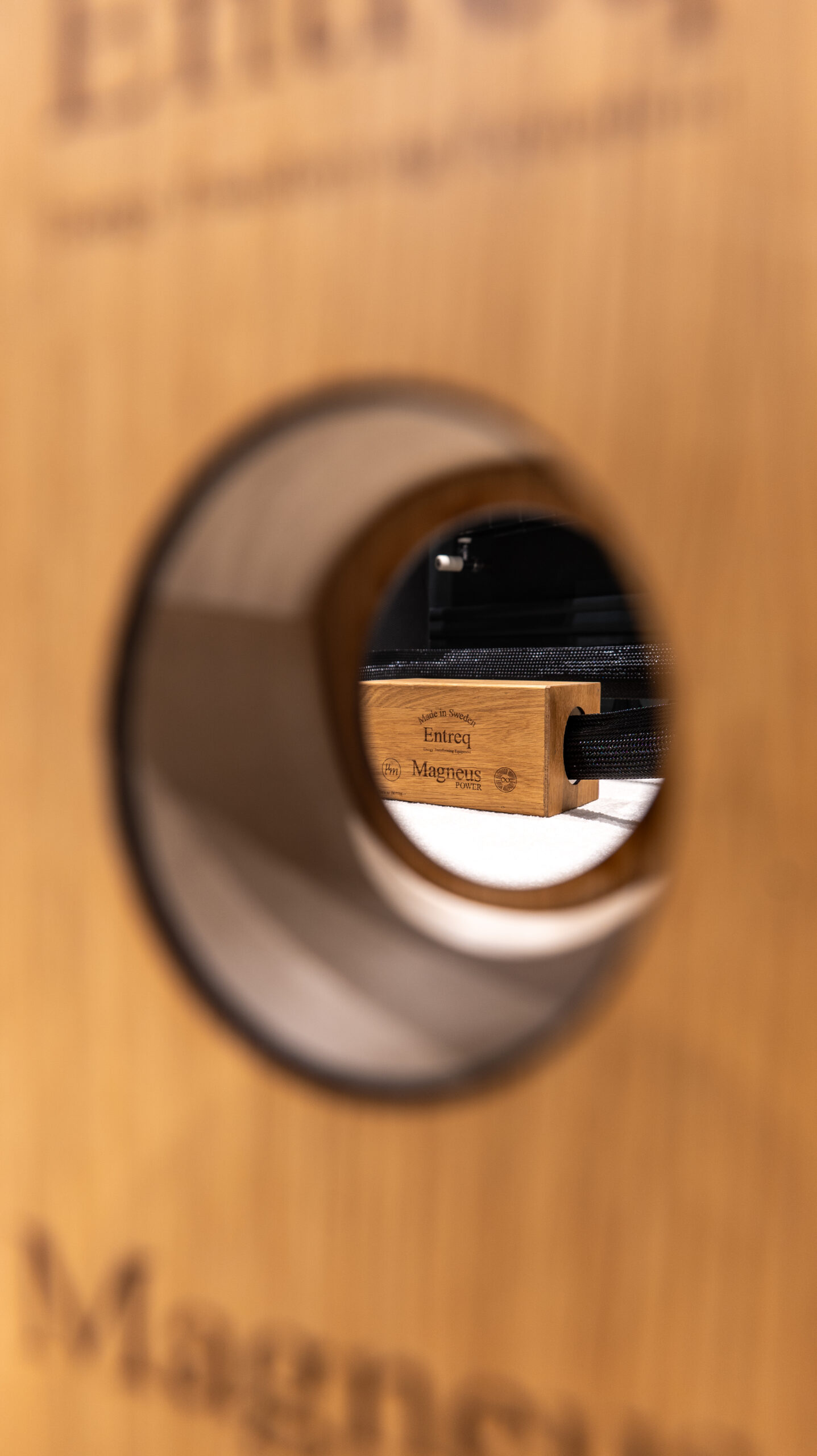
Each Magneus unit is a passive structure housing a blend of paramagnetic and dielectric materials, arranged in a very specific geometry. You simply pass the cable through the opening, that’s it – there is no electrical contact, no power supply, no adjustment.

The key idea is that Magneus doesn’t try to block or soak up the field around the cable. It shapes it, guiding it into a calmer, more orderly state. That distinction matters, and it’s best explained by what Magneus is not.

It’s not a ferrite

I’m sure most of us have seen the little ferrite clamps on computer and TV power leads. A ferrite is a single-material core that absorbs a fairly narrow band of radio-frequency noise, usually in the megahertz range. Magneus uses a mix of reactive materials and works on the whole field environment around the cable, not just one area of the spectrum.

It’s not a saturation transformer either

Some field-control products work by absorbing energy, acting a bit like a passive brake. However, brakes slow things down, and that can draw the life out of dynamics and the leading edge of notes. Magneus is deliberately an open structure with no saturating components, so it won’t build up energy over time or dull the presentation.

The Magneus range

There are three Magneus models, all built on the same principle but sized and shaped for different applications within a system.

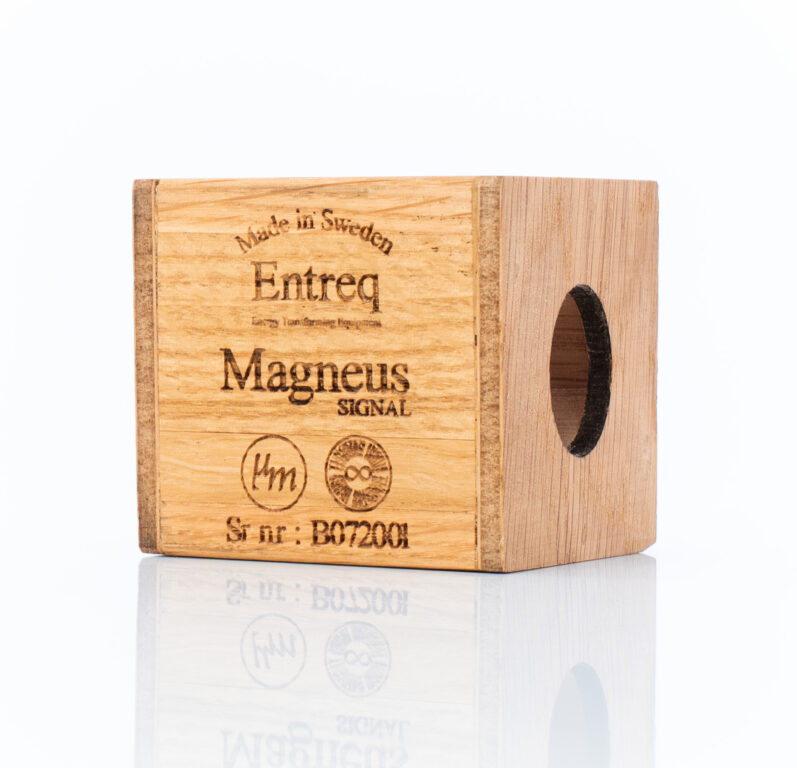
Magneus Signal: £380

Entreq Magneus Signal @ Audio Therapy


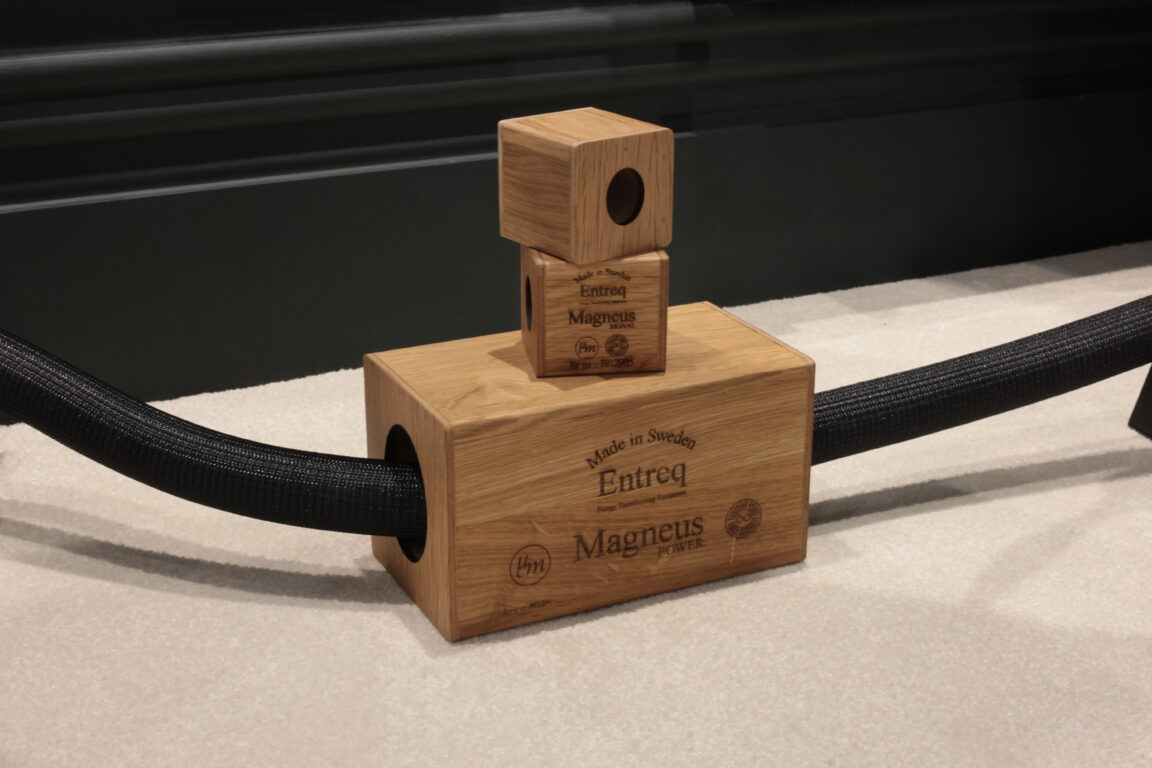
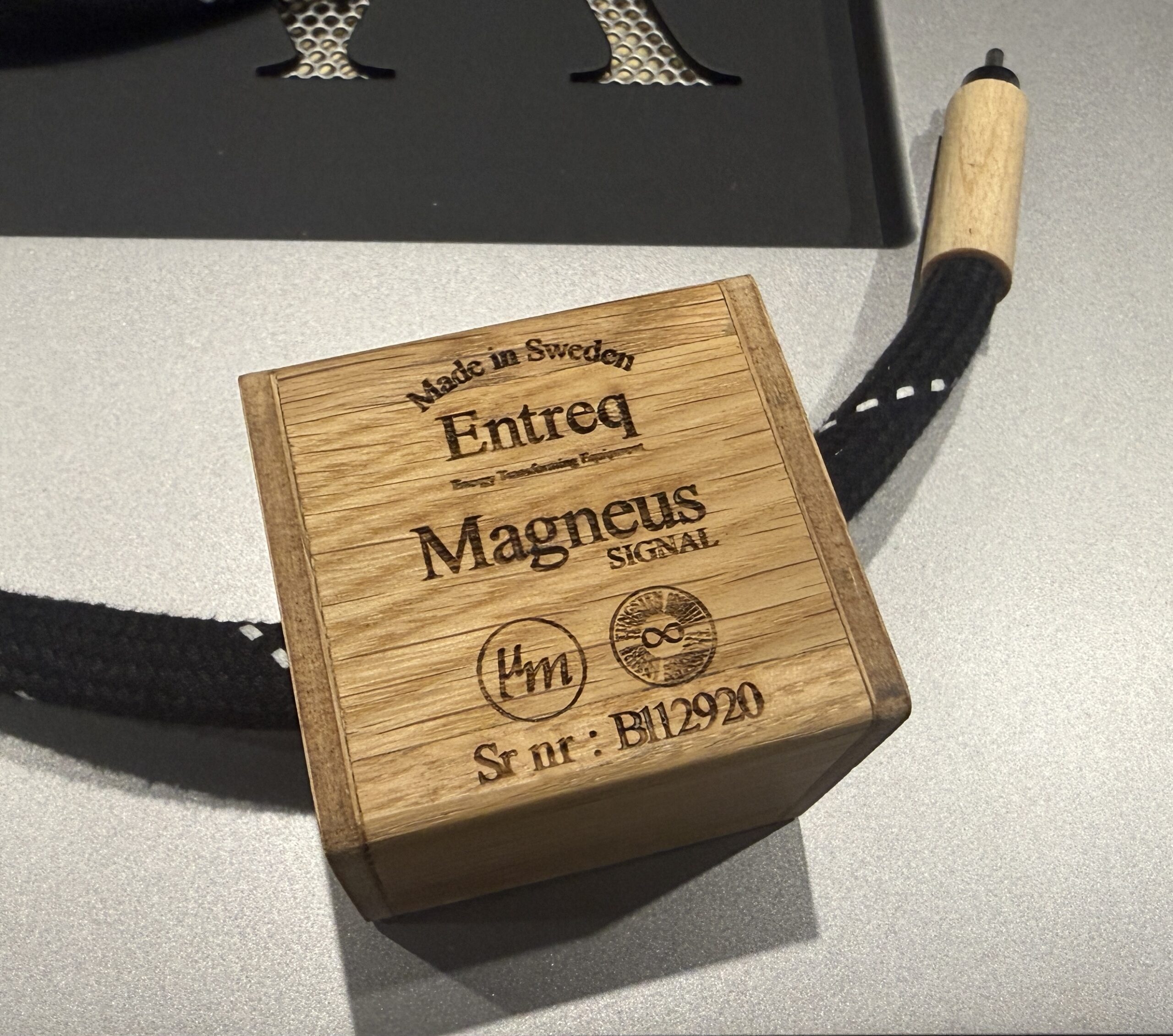
This is the smallest model, measuring approximately 60 × 50 × 50 mm with a 22 × 27 mm opening. Magneus Signal has been designed for Ethernet cables, USB cables and analogue cables, it can even be used with HDMI cables. It can also be used on ground cables connected to an Entreq ground box.

If you stream music the obvious place to start is the Ethernet cable feeding into your system. Routers are unsurprisingly rather noisy devices and it’s a pathway from the outside world which can introduce a lot of noise into a system.

USB cables are also very effective, these are arguably less commonly used these days, certainly compared to Ethernet, but nonetheless are very effective. I’ve still plenty of customers using USB to connect a Melco to a DAC for example.


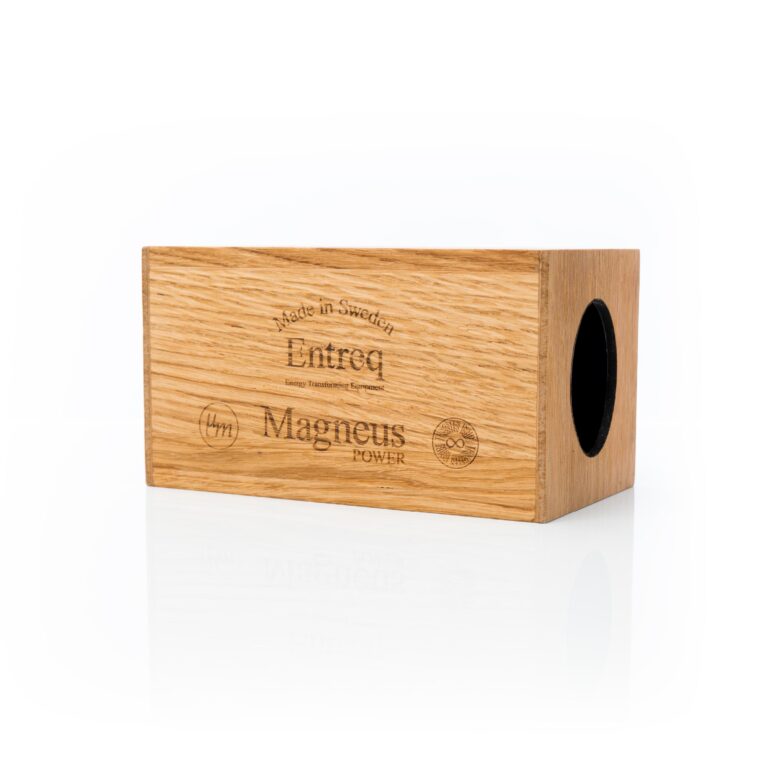
Magneus Power: £880

Entreq Magneus Power @ Audio Therapy

Magneus Power is a larger unit designed for power cables and speaker cables, it measures 180 x 100 x 100 mm, the opening is 55mm x 65mm and allow most power cables and speaker cables to pass through it.

When using this with a power cable it is designed to be positioned as close to the IEC socket of a component as possible, but if this isn’t practical it can be used close to the mains plug instead.  We got great results using one on a Shunyata Sigma X NR power cables connected to a Vitus SIA-025.

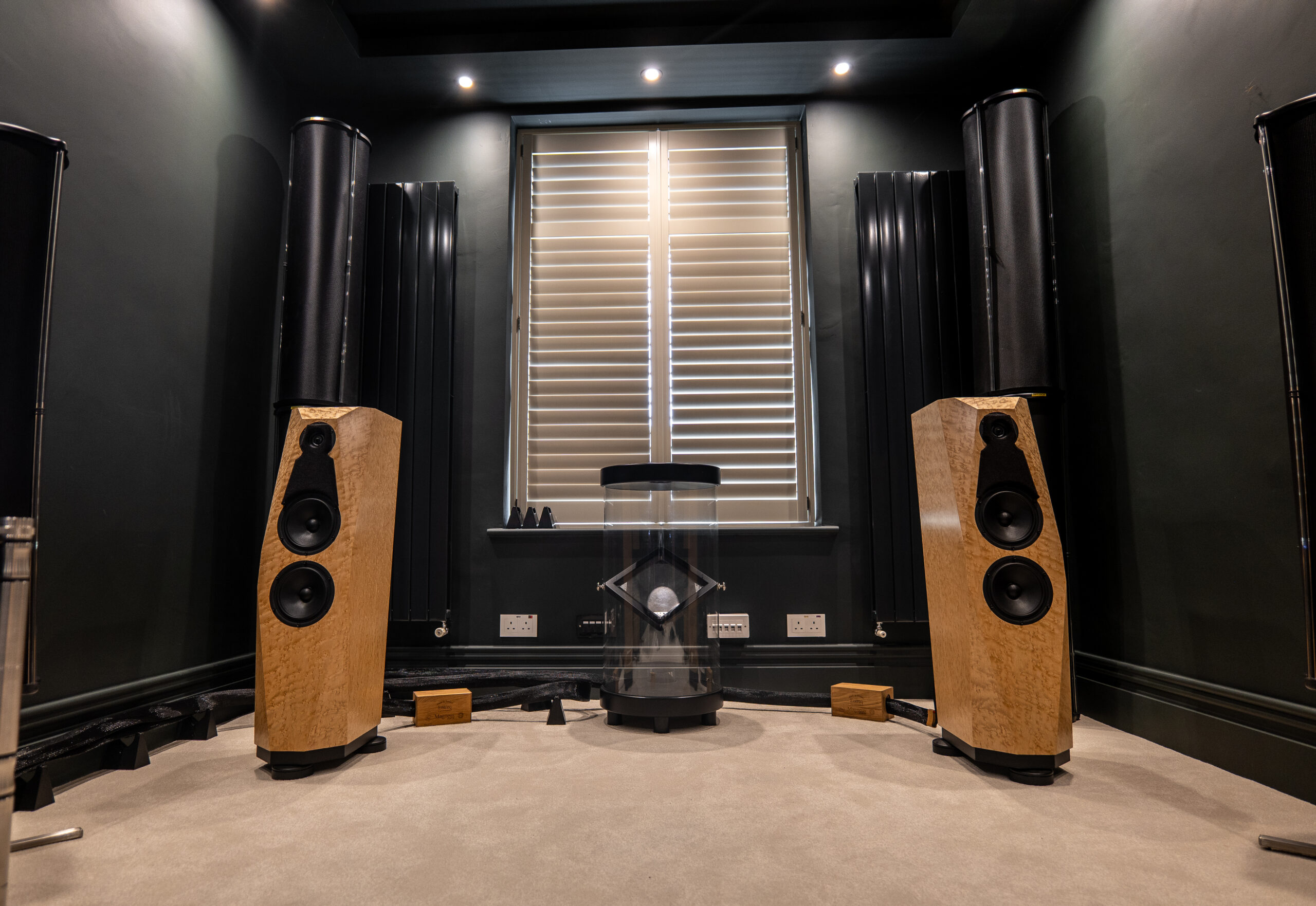
When used on speaker cables, they are best positioned behind the loudspeakers, as close to the terminals as possible ideally. So far using a pair of Magneus Powers on speaker cables has been the most popular application for any Magneus product.

They make a striking impact on the performance of every speaker we’ve tested them with to date, OePhi, Vimberg, Avalon, Kroma, Kudos and PMC so far.

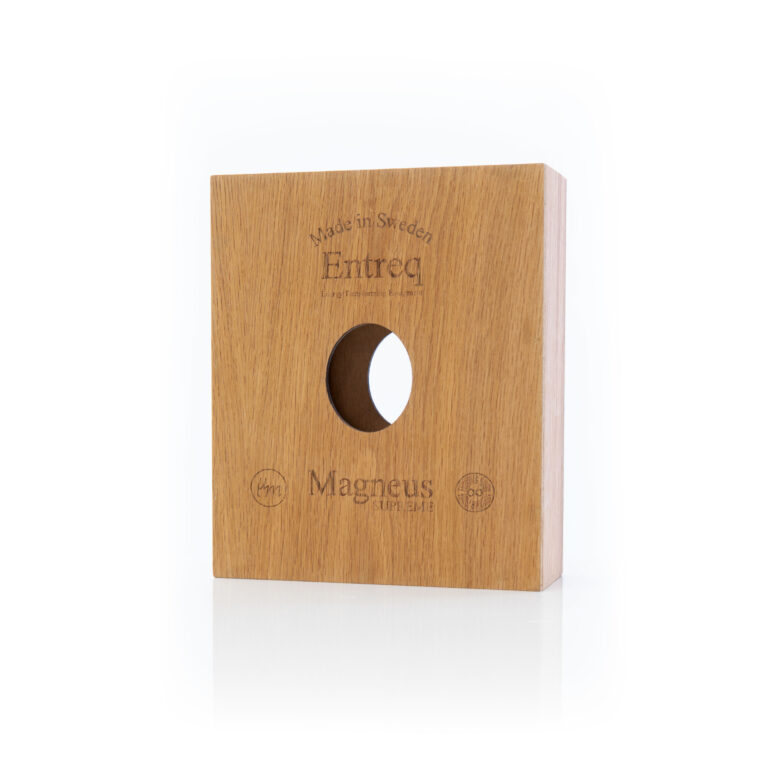
Magneus Supreme: £2,100

Entreq Magneus Supreme @ Audio Therapy

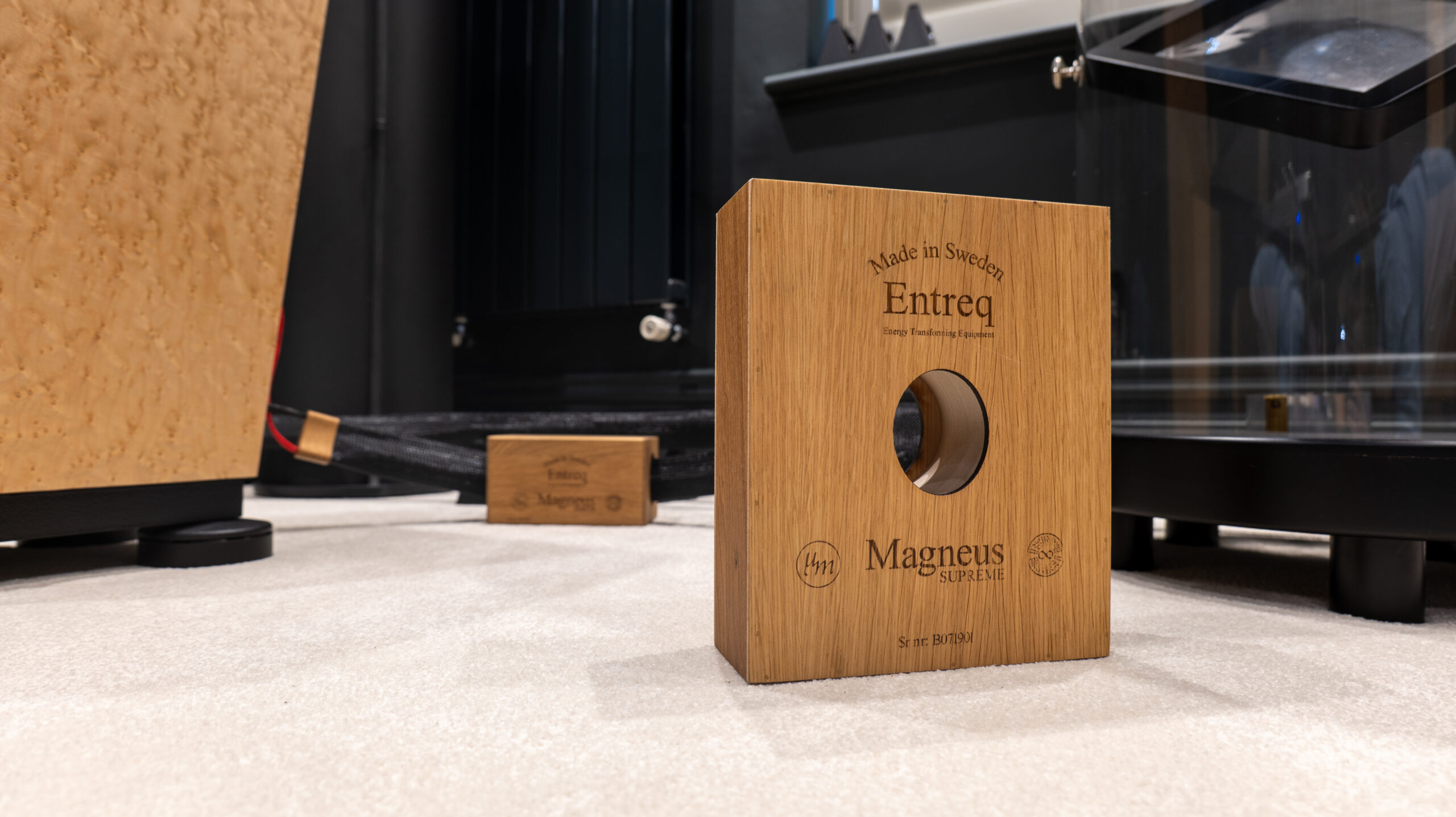
The Magneus Supreme is the largest model in the range and it’s quite a striking object. It is comprised of eight vertically oriented Magneus elements arranged in a circle, so the cable passes through a complete 360° ring. Entreq describe this as a passive electromagnetic field chamber. It measures 80 × 200 × 240 mm, weighs around 2 kg and its 55 × 65 mm opening is large enough for a large UK three-pin plug, Schuko or Furutech IEC connector to pass through.

The Supreme is aimed at the points of highest current and field intensity: the power cable feeding a powerful amplifier, or the main inlet cable to a power conditioner or distribution block.


What can I expect to hear?

The introduction of some Magneus products can have a profound impact on the musical performance of a system, more than many customers initially anticipate.

It’s important to stress that they don’t change the tonal characteristics of a system, their role is to remove a layer of ‘electrical haze and noise’ that hangs over the music. This noise is something that is unheard but once removed the benefits it brings to the music become instantly obvious. Some Entreq products can take their time to settle into a system, however the addition of these is like flicking a switch.

Refinement and calmness are 2 key words here, Magneus delivers a quieter, blacker background with more space and separation in the soundstage, which sounds steadier and better structured as a result. Complex passages of music become more coherent and easier to follow, layering and textures are more obvious as well.

Each of the 3 models has a place in a system, a single Magneus product can provide excellent results, but when you combine several of them the benefits they bring is compounded.

The 3 models are at very different price points and for customers with more modest systems the Magneus Power or Supreme may be not appropriate, but for those with larger, more elaborate systems they will be much more relevant.

The Magneus Signal is a great starting point, priced at £380 they are relatively affordable, used with an ethernet cable that feeds streaming into your system being an obvious place to start.

I recently did a demonstration using a T+A Symphonia and with pair of OePhi Lounge 2.5 speakers. The customer and I were talking about Entreq, and I showed him a Magneus Signal which I fitted to the Shunyata Theta RJ45 cable which we were using. It only took a few seconds playing the same track again for the customer to appreciate what it did. Bass notes became more controlled, more articulate and they were much easier to follow, the customer said that for £380 it was a bit of a no-brainer addition.

I’ve a customer who recently borrowed several to try on different parts of his system, he has been purchasing one every month or so, it spreads the cost and he gets to appreciate their addition one at a time. He uses a switch in his system, and he has 1 either side of the switch on the cables that feed in and out of it.

The Magneus Powers work really when installed on a power cable, but I found them to be most effective when you used in pairs on loudspeaker cable. The level of improvement they can bring to a system in this position was sizeable to say the least.

The GoGo Pengiun track Fallowfield Loops (off their most recent album Necessary Fictions) always sounds good, it’s a great recording and a brilliant album, but with a pair of Magneus Power used on the speaker cables (Shunyata Alpha X) the impact was like listening to a band playing at the top of their game compared to a band who were having an off day or weren’t really in the mood.

The music was much tighter, with improved timing and focus, the soundstage is more 3D and coherent, allowing you follow the separate elements of the music much more easily. The bass becomes firmer, more tuneful and much more articulate, we aren’t talking about introducing more bass, but better-quality bass.

Another great album that has had lot of air-time recently is Headhunters by Herbie Hancock, it’s a superb album and I’d been inspired to listen to it again after a recent trip to Ronnie Scott’s. This a tremendous jazz fusion funk album, apparently the first ever Platinum jazz album and I’ve never had it sounding better.

Gallery Image
Gallery Image

The Magneus Supreme takes things even further, this is can be used in a couple of different ways, on the power cable that connects a power conditioner to the wall or on the power cable of a large demanding amplifier.

I’ve supplied a few of these so far, a couple of strong examples are a Vitus SIA-030 and an Entreq PowerUs and in both cases the customers were both shocked by what happened, one jokingly said ‘there is no way I’m givin that back’ and words to the effect of ‘it may seem expensive on the face of it, but based on what it does to my system I’d argue its actually good value’

Perhaps more importantly than any clichéd descriptive term for how a system sounds is actually how a system feels to live with over an extended period with a selection of Magneus products in use. There is an improved sense of realism, less fatigue, listening sessions are more relaxed and importantly there is an urge to simply keep listening to more music and sessions last for longer, they make your system become an ever greater ‘time sink’!

Which Magneus is right for my system?

The only way to find out is to borrow some, as ever with Entreq it is to some degree system dependent and budget dependent.

In one system the Magneus Supreme was effective, but the customer preferred a pair of Magneus Powers installed on his speaker cables, so he went in that direction. With Entreq you can never assume that the most expensive option is the best one, it is always system dependent.

I’ve had numerous customers over the past few months borrow one Magneus product, like it, then try another, ending up with multiple products throughout their system in various combinations.

I’m not going to pretend I can give you a full physics lesson on how a passive ring of materials around a cable changes what you hear, but what I can tell you is that over the past decade I’ve watched a lot of genuinely sceptical customers try Entreq in their own systems and come back for more, time and time again and it’s happening again with these new products.

I would never ask anyone to blind purchase something on my word, or anyone else’s. Results depend on the system, the room and the what the listener likes, so the only test that really counts is hearing it for yourself.

If you’re curious about Magneus or Entreq in general and are interested in what would make the most sense for your system please drop me an email or give me a call, I’d be happy to help.

For regular product updates and to stay up to date with the latest at Audio Therapy
sign up to our newsletter below.

Your cart

No products in the cart.